MESHCORE
Smartphone
    ↓
Heltec running MeshCore
    ↓
LoRa
    ↓
MeshCore network
The Heltec runs MeshCore itself and can act as a companion radio or repeater.
Experimental networking
Alongside MeshCore, OXMESH is also experimenting with Reticulum.
Reticulum is separate from MeshCore. The two systems use different protocols and do not communicate directly with each other.
While MeshCore provides a relatively simple way to build LoRa messaging networks, Reticulum is a complete cryptography-based networking stack. It can operate over LoRa, Wi-Fi, Ethernet, Internet links and other interfaces — with several types of connection used at the same time.
This makes Reticulum particularly interesting for experimenting with resilient networks that extend beyond LoRa messaging alone.
Both systems can use inexpensive LoRa hardware such as the Heltec V3 and V4, but they use it differently.
Smartphone
↓
Heltec running MeshCore
↓
LoRa
↓
MeshCore network
The Heltec runs MeshCore itself and can act as a companion radio or repeater.
MeshChatX on smartphone
(or Windows/Linux PC)
        ↓
Reticulum
        ↓
USB / serial
        ↓
Heltec running RNode
        ↓
LoRa
        ↓
Reticulum
With Reticulum, the Heltec normally acts as an RNode radio interface. The Reticulum stack and applications run on the connected smartphone, Windows/Linux PC, Raspberry Pi or other host.
Reticulum over LoRa is not LoRaWAN. LoRa is simply one of the communication interfaces Reticulum can use.
An RNode provides a radio interface for Reticulum.
Supported LoRa development boards, including versions of the Heltec V3 and V4, can be flashed with RNode firmware and connected to a device running Reticulum.
If you already have a spare Heltec, you may therefore already have most of the hardware required to start experimenting.
The browser-based RNode flasher provides one of the easiest ways to install RNode firmware on supported hardware.
Check that your exact board and hardware revision are supported before flashing.
Reticulum provides the networking layer. Applications built on top of it provide messaging, browsing, file transfer and other services.
For someone new to Reticulum, MeshChatX is a good place to start.
It provides a graphical interface for messaging and exploring Reticulum and can be used on smartphones and computers.
For a first experiment, running MeshChatX on a Windows or Linux PC can be particularly straightforward. The desktop application is easy to use and avoids the need to install the Android APK manually, since MeshChatX is not currently distributed through Google Play.
Smartphone
    +
MeshChatX
    +
RNode
    +
LoRa

Windows / Linux PC
        +
MeshChatX
        +
RNode
        +
LoRa
RETICULUM SOFTWARE
Turn supported LoRa hardware into a Reticulum radio interface.
RNODE FLASHERA graphical way to start messaging over Reticulum.
SOFTWAREInstall Reticulum and learn how its interfaces work.
GETTING STARTEDReticulum can also be used to distribute information rather than just exchange messages.
Nomad Network provides messaging and lightweight network services over Reticulum.
It can serve pages written using Micron, a compact markup format particularly suitable for low-bandwidth networks.
This means that useful information can be published and retrieved across Reticulum without relying on a conventional website or Internet connection.
f7a5ca234e99ed1ca33261183ab21348:/page/index.mu
This is one of the experimental RADIOXFORD pages available through our Reticulum infrastructure.
This is a Reticulum/Nomad address, not a conventional HTTP URL.
Oxford experiment
OXMESH is primarily focused on improving MeshCore coverage across Oxford, but we are also running a small Reticulum experiment alongside it.
The aim is to explore RNodes, LoRa links, transport nodes, lightweight network services and hybrid radio/IP networking.
One RADIOXFORD Reticulum node currently has an active RNode LoRa interface, allowing Reticulum traffic to be transmitted and received directly over LoRa.
RX 867.500 MHz | BW 125 kHz | SF9 | CR5
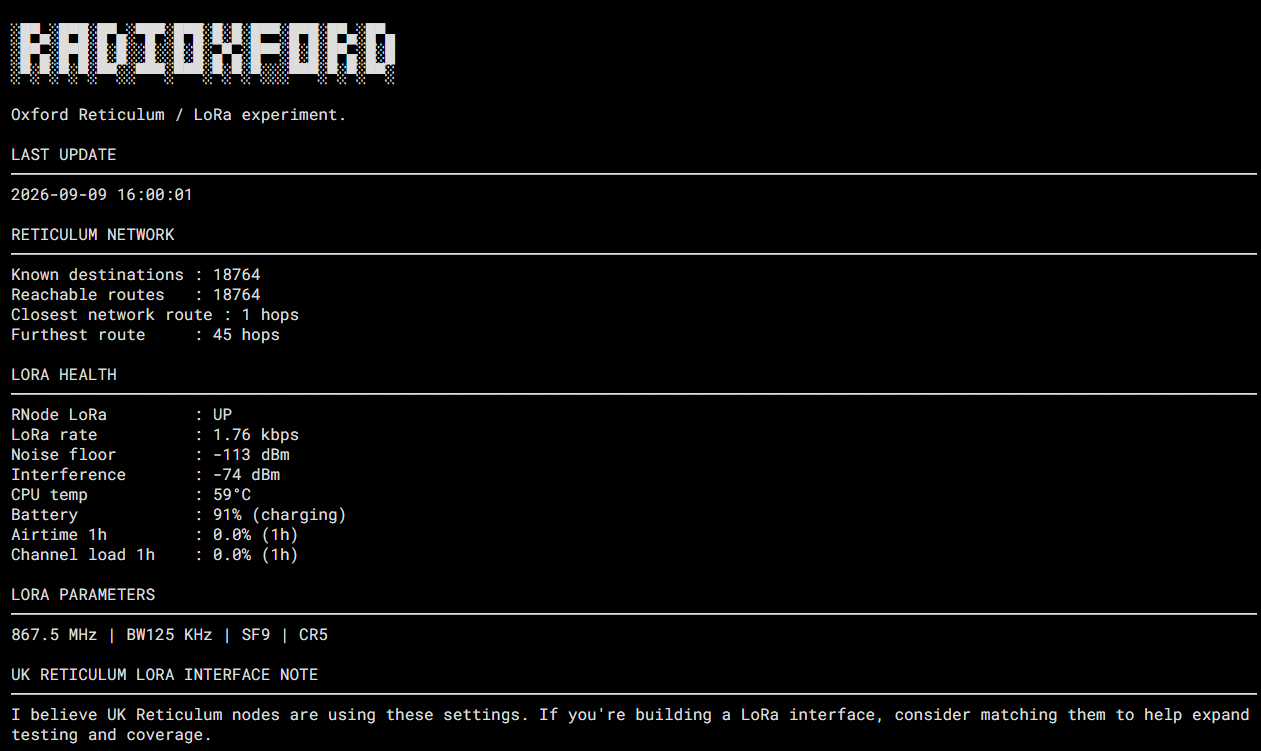
The LoRa interface provides a local radio path into Reticulum while the node can simultaneously make use of other Reticulum interfaces and routes.
A second experiment uses Reticulum to distribute information collected from the OXMESH MeshCore network.
An OXMESH observer collects network activity such as known nodes, repeaters, recently observed stations and packet statistics.
That information can then be published as a lightweight Micron page over Reticulum.
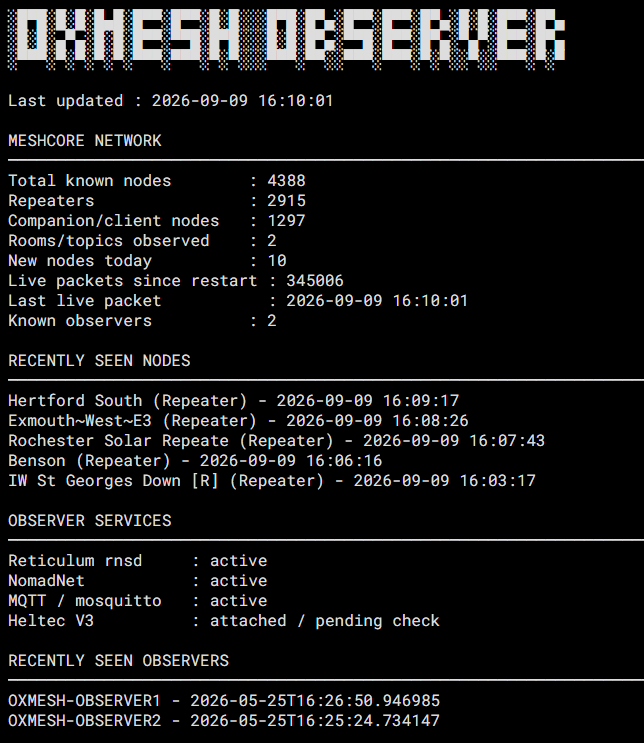
The flow is simple:
MeshCore network
       ↓
OXMESH observer
       ↓
Network statistics
       ↓
Micron page
       ↓
Reticulum
The two remain separate networks. Reticulum is simply being used here as another way of distributing information collected from the MeshCore infrastructure.
Reticulum is a decentralised and experimental networking ecosystem used by people and projects around the world.
OXMESH does not control the wider Reticulum network and is not responsible for content or activity from other users.
This page is intended to explore and experiment with currently available technologies. Their inclusion on OXMESH does not represent endorsement of third-party content, services or activities.
Users remain responsible for the operation of their own equipment and compliance with applicable regulations.
You do not need to choose between MeshCore and Reticulum.
Much of the same inexpensive LoRa hardware can be used with either system, although different firmware and software are required.
If your main aim is to join the Oxford LoRa messaging network, MeshCore is the easier place to start.
If you want to experiment further with networking, RNodes, multiple interfaces, transport nodes and services running over a resilient network stack, Reticulum offers much more to explore.
NEW TO LoRa?
START WITH MESHCORE.

WANT TO EXPERIMENT FURTHER?
TRY RETICULUM.
MESHCORE ≠ RETICULUM

SEPARATE NETWORKS · SHARED CURIOSITY